Sunday, 18 January 2015

EPOC – Urban Myth or Fat Burning Miracle?


EPOC stands for “Excess Post-exercise Oxygen Consumption” and works a bit like my log burner – takes a bit of time to get going but once it is fired up the heat it produces is massive and it keeps warm even when the fire has gone out. Keep that image in your head.


Another phrase you may have heard in relation to this is “Metabolic Training” and these are both basically the same thing.  Our metabolic rate tends to be fairly steady – it increases when we have done exercise or when we have eaten food, it can also decrease in times of “starvation” -which is a good thing if you are starving – but not if your calorie controlled diet is the reason. These increases and decreases are temporary so we need to keep priming our metabolism to keep burning calories at a higher rate.

Each day we need a basic number of calories to keep our body ticking over. This is called your “Basal Metabolic Rate” or BMR.  This calorie intake is based on your weight and your activity level. For a rough calculation times your body weight (kg) by 25 cals e.g. 70Kg x 25 = 1,875 calories.  Now you can add a bit more – so 20% extra calories if you lead a “sedentary” lifestyle (this means that you do less than 30 minutes of activity a day), add 50% extra calories if you are active (more than 30 mins continuous exercise that gets you out of breath) on 3 days a week and a whopping 100% more calories if you are active 5-7 days per week.  The things that can affect your BMR are – age – the older you are the less muscle mass you have and therefore your BMR drops (get to the gym!!), Body Temp – BMR increases with body temp (see above comment in relation to the fire and your hot burning face when exercising) , being “stressed” – and not just your everyday stress but also that bit of stress you feel when you are pushing yourself in exercise or even “exercise excitement” (yes, this is true and it is when you are looking forward to training..!)   - and finally, hormones with adrenaline (which is released when you exercise or are stressed) and thyroxine can increase BMR.

So, can you now begin to see a link between increasing your BMR and how exercise can help you?  When we start to exercise our demand for oxygen increases – you know this to be true as you will start to get breathless as the body increases its demand! 80% of your blood in your body is held in the central core, but when we exercise 80% then is circulating in the legs and arms – which is why we need to “warm up” and move the blood around the body. This can take about 5 minutes but is much quicker as you get fitter. You know this is happening as you can have red blotchy legs or arms and definitely a red or hot face

So, EPOC stands for our increased demand for oxygen AFTER our workout which then continues to keep our metabolic rate burning at the higher level – much like my log burner heating the room even after the fire has gone out.  Some research indicates that your metabolic rate can stay high for up to 2 hours following exercise. Here is how to maximise this. First, a look at fat burning...

FFA stands for “free fatty acids” and these are released into the blood stream when we are exercising to produce energy. This is Fat Metabolism – and by now I am sure I have your attention! Yes, to increase your fat burning you need to remember all the above things. 1. You have to get warm and slightly out of breath 2. You need to do this on a regular basis. BUT there is one thing that stimulates fat released and that is low blood glucose (sugar). We have already talked about this in a previous post and the necessity to eat well before a workout (inc the day before) and not to eat sugar during the workout, or before the workout (unless you haven’t eaten all day otherwise you may faint!) or immediately following your workout. This means when you are exercising (and starting to increase your oxygen demand) you will begin to burn fat as part of your demand for energy.  This fat burning CONTINUES after you have exercises as you return the body to its normal state. This happens following weight training as well as endurance work – recovery is fat burning.

When you train on a regular basis the body gets used to storing more carbs and fat - and trained muscles access your fat stores QUICKER and more efficiently than untrained muscles. There can be up to a 30% increase in fat burning properties in trained people than beginners – so yes, they burn more calories doing the same workout...And this happens when you train at least 3 times a week – and can result in significant weight loss. Consistency is the key here and the exercise can be of your choice but at least 20 mins continuous.
So in order to maximise EPOC please follow these guidelines:

1.       Metabolic Rate is affected by food and exercise
2.       Make sure that you have sound nutrition before training
3.       High use of sugar in the day will stop you fat burning effectively
4.       Try not to eat an hour before training
5.       Exercise can raise BMR and keep it elevated for around 30 mins post exercise – this increases fat burning
6.       Try not to eat sugar immediately after training – wait at least 30 mins and then, if possible, eat protein
7.       Your body needs to be well hydrated for these to work effectively – so keep up your water intake.
8.       Exercise on a regular basis to maximise 


Saturday, 17 January 2015

Great Shoulders?


A "selfie", taken in the summer on the deck at home.  Hair salty from a swim in the sea, and a glass of cold wine - I may bang on about being healthy, but there is moderation in all things!  Following posting this on Facebook, I got lots of comments about the shoulders.  So, here is a shoulder workout that you can do to get tone and definition. It is extremely hard to get bulk in the upper body for females, so please don’t be worried – getting size involves diet changes and lifting in a specific way. This work out will give you great shape and tone, will improve posture and balance out your body. Enjoy the workout, and even a glass of wine when you are done :)


Shoulders – have two main areas to work, the big Trapezius muscle and then the smaller deltoids. There are others which join in, but we will only be looking at these as the prime movers. 

1.Upright row – use a bar or a heavish weight on an upright row machine. Although you can do this with dumbbells, I find that you get a better response with a heavier weight and a bar is easier to manage than dumbbells. If the dumbbells are of sufficient weight I often find them too big for my hands and I get cramp. But if you prefer dumbbells then please aim for heavy ones.  Wide stance with feet, narrow grip with hands (extend your thumbs to touch and then tuck them under the bar). Stand with amazing posture to get that line of gravity through the top of the shoulders. Lift the bar up under the chin, and lift the elbows high – you should be showing your armpits at this point. Lower with control to the starting position without letting the weight drop heavily. Brace/tighten the core as you do this, and a heavy breath out when it starts getting tough. Aim for 10 – 15 reps max.

2.Bent over rows – if you can, stay with bar here. Narrow squat position. Squat a little (look over the cliff position) and keep the bar dead against your thighs, row or draw the bar up to your body – aim for the space between the belly button and pubic bone. Brace the core. Use the shoulders here - not arms – and draw the shoulder blades together.  Lower with control to knees. Aim again for the 10-15 reps.

3.Flys – you stay in the forward row position (please don’t do these exercises next to each other as your core will tire and your back will suffer). Using dumbbells, lift both arms out to the side again think like angel’s wings, and draw shoulder blades together. Lift your head a little as if you are peeping over the top of your sunglasses.

4.Shoulder Press – you can do this with Bar or dumbbells, and I would recommend that you do this exercise with both. I have written a programme below, so you will repeat this with both bar and belles. Split stance like a calf stretch, even lift onto the toes on the back leg if you want to stabilise further or help your back. Get the bar to your shoulders - hands in line with shoulders and press weight above your head - brace your core and breathe out. Aim for 10 – 15 reps. The position is similar with dumbbells but you have a different range of movement, so take the arms more in an arc position – do one set with palms facing towards each other and another set with the palms facing towards the mirror as you are looking at yourself.

5.Lateral Raise – change to dumbbells here. Wide stance and fab posture.  Bring the dumbbells in front of your body to start with, bend elbows slightly, then lift out to shoulder height keeping a slight bend in the elbow – think of like wings – pull the shoulder blades down as you do that. Lower with control to starting position. There should be a degree of effort involved when lifting this – so don’t have light dumbbells.  If you can do more than 20 then change to a heavier weight. You want to know you are lifting something significant.

6.Forward Raise. Same stance as Lateral but hold the dumbbells against your leg with palms towards your thighs. Lift arm directly in front of you one at a time – try not to lean but think about the shoulder blade pulling down the back. Lower and repeat. If you can, try both dumbbells, and then try lifting higher than head.

When training, do shoulders every other day and mix and match the exercises. ALWAYS have amazing posture, work until the muscle burns, rest then repeat at least 3 times. You should work till you find it tough. If this is doing loads of reps, then up your weights. Aim for 10 -1 5 reps. Don’t be surprised at how wimpy your arms are in the beginning! Up your protein intake, up your water, drop some body fat to be able to see the definition

Thursday, 15 January 2015

Delayed Onset Muscle Soreness - DOMS


Since Christmas, there seems to be a great deal of us posting (and moaning like my husband) about the aching sore muscles you get when you go back to exercise after a long rest, or even when you try a new kind of exercise. Don’t get me wrong, this pain is pretty bad! Even though it didn’t feel that bad when you were exercising or the day after, the burning searing pain that follows can be enough to put anyone off exercise...... 

So here is a breakdown (excuse the pun) of why your muscles ache to the point that you may whinge out loud walking down steps.....and, how you can help yourself ease the pain that doesn’t happen immediately, feels fine when you are sting still but makes you moan in agony any time you try and move – or even just touch your sore muscle........

Muscles are made up of long fibres of protein links. When you stress these links, they grow stronger by creating more links through muscle bonds..

Our muscles contracts in two ways – with gravity and against gravity.  It is called a positive or “concentric”  contraction when the muscle pulls. For example, lifting a weight in a bicep curl, standing up from a squat or lifting phase of a sit-up.  Under a concentric contraction, the muscle fibres pull together and shorten.  When the muscle then lengthens under tension it is called a negative or “eccentric” contraction.  This is all about controlling the weight that you are lowering towards the ground so the lowering of a squat, the lowering of a chest press or even running downhill. This controlled lowering is all about the control we have when moving.  Muscles never push. They only pull.  The return phase of the movement can be likened to lowering a person over the cliff on a long rope...

DOMS seem to occur most when the eccentric action of the muscle contraction is highly activated.   It is believed that the soreness felt  arises from microscopic tears of the muscles fibres. Although there does not seem to be any link between the amount of tearing and the amount of pain. DOMS generally happens when you try a new type of exercise, or return to exercise following some time off, or even when you make your current workout harder.


The good news is that once you have had DOMS with a new exercise or increased intensity then the body readily adapts to this and changes so quickly that you are unlikely to feel that sore again.  Further, whilst exercise at this point is far from your mind, it appears that doing even more exercise the following day actually helps recovery. This  “exercise induced analgesia”  is commonly seen in endurance exercise such as running, cycling or swimming where a “recovery run” can help the following day – that is, if you can face it. Although we do get strong DOMS from weight training, heavy exercising won’t help with this, but certainly other exercises will or even doing light weights.


Massage has been shown to help recovery and more recently the use of compression garments seems to have a positive effect not only on the recovery of muscles, but also to help prevent DOMS when wearing them to exercise – unfortunately though, compression tights won’t make you run faster....

Including protein in the recovery phase can help and you need to do this pretty sharpish after exercise for maximum benefit and have extra protection by consuming protein before your workout. Weirdly, using anti inflammatory pain killers has been linked with extending the pain of DOMS as it interferes with muscle recovery. But hot baths or ice baths do seem to help.

Doing a warm up and stretching beforehand seems to have little impact on the amount of DOMS you will get. DOMS is just strongly linked to the type of exercises – that eccentric phase we talked about.  Stretching afterwards, although feeling good and well worthwhile, still won’t protect you from DOMS sorry.

So, it looks likely that if you are new to exercise, started training after a break at Christmas, or even starting to increase your training, then you are likely to DOMS.  Although this will affect your exercise performance in the short term, one bout of DOMS can create some adaptations to your muscles that will have a protective effect on future workouts.  Build up your training gradually and go out and buy some compression tights....x


Does weight matter


 Often the starting point of most fitness drives after Christmas is to lose the “weight” that we have put on.  A weekly or even daily “weigh-in” can become the b all and end all of the goal.  Is it worth it?


When you weigh yourself, you weigh the total of you. Your hair, your skin, bones, tendons, the food you have eaten, the drink you have drunk and so on. The total sum of this can fluctuate throughout the day and from day to day.  What drives most people is to lose body fat. We want a leaner body where we can see the definition of our shape, for clothes to sit nicely and not to feel uncomfortable, to be able to move with ease and not be distracted by too much wobble.

Ideally, we would want to measure the percentage of our body that is fat.  This is not so easy to do although not impossible.  You can buy some scales that aim to give you a rough estimate through sending an electronic signal through the lower body and measures the ”impendence” or the slowing of signal by it having to travel through fat.  This is the most common way that we see this done in everyday use – it is basically, stepping on the scales. Being dehydrated does affect the reading, plus there will always be a slight error margin for the machine itself.  You can use callipers to pinch an inch – but you need help to do this and again there is room for human error.  The most effective way is to be weighed under water – not easy to do.  So, how can we stay motivated to keep at our goal when after a week of working hard and eating well, the scales may not have changed, or you have only lost a pound?


First thing to do is to measure yourself at the chest, waist, hips and thighs. Repeat these measurements on a weekly basis.  Secondly, get an item of clothing that feels a bit snug and try it on each week. Finally, (not for the faint hearted) take a photo of yourself in underwear each week to see any changes.

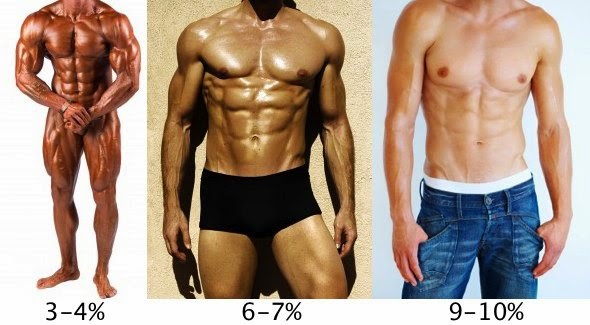
A normal range of body fat is

Women
Men
Essential Fat
10-12%
2-4%
Athletic
14-20%
6-13%
Fitness Level
21-24%
14-17%
Healthy  Range
25-31%
18-25%
Overweight
32% plus
26% plus
Obese
40%+
32%+

These images will give you an idea of what this looks like (thanks to nerdfitness for these fab pics)


The next question is how do we go about reducing body fat?  

It has to be a combination of diet and exercise.  The diet needs to be as “clean” as you can, so have a look at some of the earlier posts as well as keep an eye on ones coming up. The “Tough Love” diet will get things going, or even the 5:2 if you prefer.  I will keep posting exercise challenges and food ideas for you as well – but today, strip off, weigh, measure and photograph. We are looking for 1-2lbs weight loss a week – more than that can be down to losing water and muscle mass so be careful. Xx

Wednesday, 14 January 2015

Green Day


Today, we will be eating our greens!  Try if you can to have around 3-4 cups of green tea – you can have flavoured ones if the real thing is too bitter for you.  Don’t drink on an empty stomach as it can cause nausea in some due to its strong properties – and these are what we are looking for – high in antioxidants and even some research indicating that it helps increase metabolism and therefore, potential to speed up weight loss.


Breakfast: - Green grapes in Greek yogurt with some pumpkin seeds on top, or, Spinach (make sure it is squeezed dry) with poached egg on top – see picture which also has ham.  Or porridge with sliced kiwis and honey

Lunch: - Rocket salad with chicken breast, parsley, peas and some butter beans and some raita (yogurt with mint and cucumber).  Wholemeal Pitta bread stuffed with tuna, salad and endame beans or Broccoli soup with wholemeal bagel (to make soup, sweat an onion with a carrot and even a piece of celery if you have it. Add a whole head of broccoli and a handful of rice. Cook in a litre of stock for about 30 mins. Blitz (you can add a bit of stilton cheese if you want at this point). Store in fridge and it should keep for a few days)


Supper: - Roasted courgettes with grilled halloumi cheese sprinkled with chilli if you wish, add some and chopped cherry tomato salad, or Green lentils (sweat onions with some rosemary and garlic, add 250g lentils –green or puy – cook in 1 litre stock in the oven for one hour. Add some oil and vinegar (about a tablespoon) when finished. Leftovers can be used in salads during the week) and have with salmon or other fish and some green beans. Or have the broccoli soup as above with some toasted Pitta bread and small amount of cottage cheese.


Snacks: - one green apple with handful of pumpkin seeds or a kiwi with some almonds, Greek yogurt with pear and runny hunny


Exercise- get outside in the greenery if you can! So 20 mins walk before breakfast, lunch and tea – run if you want, but the key here is to prime the metabolism with a moderate level of exercise before eating. Add in 100 sit-ups – can be done in 4 sets of 25.  Or do one long walk - about 10K.  Walking or running outside has been shown to have a positive effect on mental well-being as well the physical benefits – so get out of the gym if you can J


Monday, 12 January 2015

Colour Challenges - Red

The general idea of these is to set up meals and activity around a colour.  This will give you a menu for the day in terms of nutrition as well as give you suggestions and ideas for some activity.  Most of the workouts are based around not going to a gym as I realise many of you may not be able to do this - however, please stick to your normal routines if you are a regular at your local workout place!  The food choices are "clean" so as free from too many chemical processes as possible, and designed for a healthy living rather than weight loss - however, this might be a happy side effect for many of you :)

Today is Red...


For Breakfast, think about some of the following:  Porridge with some red berries (buy fresh or just have a tub of frozen ones in the freezer - you can add a dollop to the hot porridge - it will cool it down and defrost at the same time!). Or sliced beef tomatoes on top of wholemeal bread with a small amount of salt and some pepper. Or Fresh strawberries with some granola and Greek yogurt.  If you don't do breakfast, think about a smoothy - cranberry juice, ice cubes, banana (with yogurt if you like it) or even strawberries in a protein shake.

For Lunch - see picture above, with is tomato salad with feta cheese, butter beans, red lettuce and basil, or have tuna with spicy tomato salsa (make your own with tomatoes, onion, and parsley) and some red kidney beans, or have homemade tomato soup (sweat some onions a carrot for 5 mins, add a kilo of fresh tomatoes or even a tin if you don't have any, some parsley and a handful of rice.  Cook for 30 mins, blitz and season to taste - use chili if you want.  Or roast a tray of sliced red peppers, when they come out, sprinkle some cous cous over the top - these will absorb the juices and flavour - serve with parsley,chick peas and pumpkin seeds.

For Supper - Roasted Salmon with green beans and sweet potato, or refried red kidney beans (sweat a spring onion with cumin seeds then add a half strained can of kidney beans and a shot of expresso  - if you don't want expresso just use the whole can of liquid. Cook for about 15 mins till nearly all liquid has gone. Mash up with a fork and add a drizzle of oil with some seasoning) with a tin of mackrel or pilchards in tomato sauce or some grilled halomi cheese and green salad. Pudding is stewed berries with greek yogurt and runny hunny or strawberry granita

Snacks - one choice for mid morning, mid afternoon and before bed if you are still hungry. Granola with strawberries, rasperries with a handful of almonds, Flapjack with fruit filling, pot of cinnamon porridge, handful of walnuts with 3 small cubes of red Leicester cheese

Exercise is cardio of course and your main aim is to get a red face :) so, Running or jogging for 30 mins. Walking is allowed if you are new to this, but each of you have to add 5 sprints for at least 10 seconds within this. Set up your smart phone to get the timings right. You will need 1-2mins recover.  Or 3 sets of 20 squats with 5 power squats at the end of each set (squat and jump up with both feet off the floor) interspersed with lying down on your stomach and getting up off the floor to standing x 5 times with a 15 second plank. So squat, power squat, lie down get up 5 times - then 15 sec plank (longer if you can) and repeat.  Or go to a high intensity group exercise session for at least 45 mins. 

Sunday, 11 January 2015

Bingo Wings and Guns


Today we look at creating good shape and tone to the arms and part of the shoulders. The muscles we will be looking at are – the biceps, triceps and deltoids. Although with one name each, these muscles have what is known as different “heads” – so think of 2 or 3 strands coming together at one point. So although the end point it the same, the leads of the muscle attach at slightly different places on the body – for extra strength and stability – but it means that you must do more than one type of exercise to work these muscles efficiently.

The biceps are a classic example of this with 2 (bi) heads and the attachment points are not only what make this muscle extremely strong for its size, but also means you must be particular in your posture when exercising.  The origin of the muscle is situated on part of the forearm, with one head travelling through the body onto the internal part of your shoulder blade, and the other to the front of the shoulder. The way that this crosses the elbow means it can pull and rotate the arm at the same time. To work this muscle efficiently (and reduce injury) to must stand up straight, brace shoulders and lift chest.
Triceps, as the name suggests, has 3 insertion points so needs different exercises to work this competently. The triceps run down the back of the arm and can be the not so attractive hanging down bits called the “bingo wings” - derived from arms being shaken as they are raised when shouting bingo (!!) – So if you want to wave with confidence, then have a look at this web page - http://www.nhs.uk/Livewell/fitness/Pages/bingo-wings-blaster.aspx

Finally the Deltoids form part of the shoulder, wrapping around the top of the arm – and I could put this in the shoulder part to, but many of the arm exercises involve some part of the delt, so here they are. There are three heads to this muscle – front of the body (anterior) side (medial) and back (posterior). So when you are doing press ups and working the triceps, the anterior deltoid helps, and when you are doing triceps kick backs, then posterior deltoid helps.

For those of you not already lifting weights – why??!! Apart from the obvious benefits of increased bone density and increased metabolic rate there is also the awesome feeling that comes from pushing a heavy weight that is indescribably good...Please spare me any misconstrued thoughts about “getting big” unless of course you know something that is to do with drugs. Simply, being in the gym will tone and shape the arms, improve posture, increase calorie burn at rest, increase fat burning in the 2 hours following training and it feels great. Do, Bicep curls, tricep press or push, chest press, press-ups, dips, lat pulldowns upright row, bent over rowns, rows, Kickbacks, shoulder press – use anything heavy from tins to cartons of milk. Get onto YouTube and search away or join the gym or come to classes such as Bodyfit.. Much to gain and nothing to lose – well, apart from wide flappy skin hanging off the back of your arm...........